CASE STUDY
Improving Vanta Agent Discoverability

COMPANY
Vanta
MY ROLE
Lead Product Designer, Vanta Agent team
TIMELINE
May 2026
PROJECT OVERVIEW
How I made Vanta’s agent easier to find, understand, and use as the starting point for real work.
The opportunity
Our vision for the Vanta agent is that using it should feel like hiring a compliance expert: someone who knows your company, takes on real work, and is always there when you need them. The agent was steadily growing into that role, with broader coverage, deeper company context, and saved memories.
The experience didn't match yet. A compliance expert you can't find, or one you mistake for a basic chatbot, isn't much of an expert. Only 2% of workflows began in the agent, and our goal was for most Vanta workflows to begin there by the end of 2026.
The problems we were solving
Customers couldn't find the agent. Customer success teams reported that most customers on their calls had never tried it until a CSM walked them through it, even though they loved it once they did.
Customers didn't know what it could do. Most assumed it was a basic chatbot, not something that could take on real compliance work.
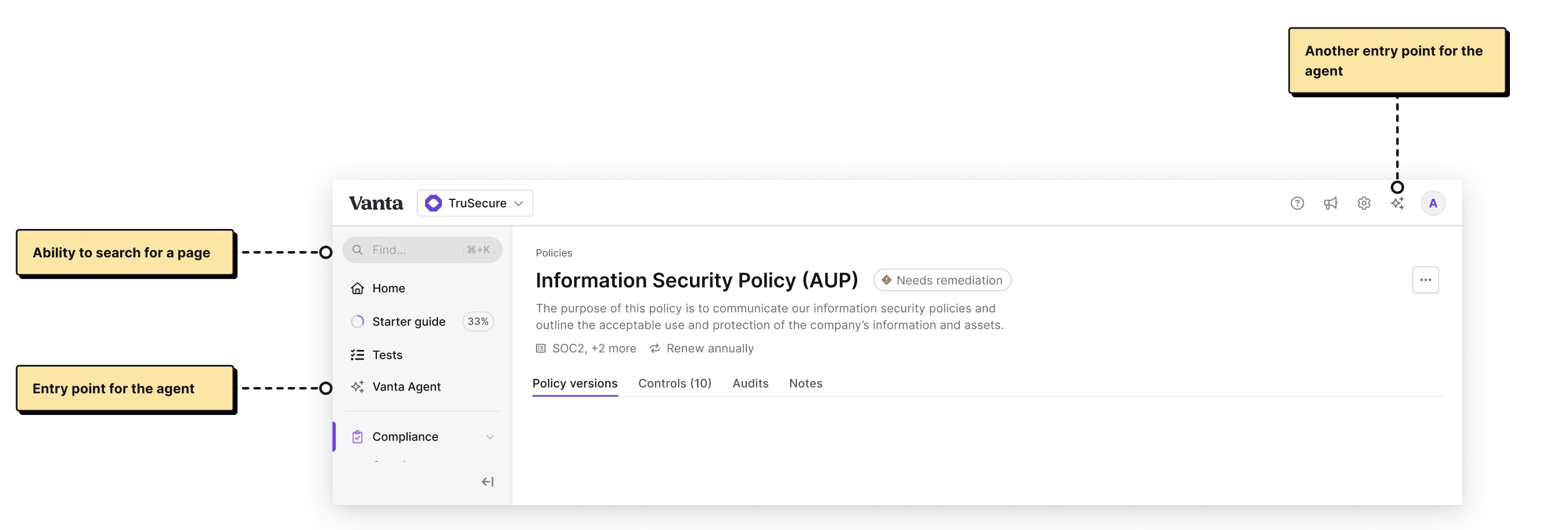
Screenshot of the entry points prior to us making changes. Despite many entry points, usage was low.
APPROACH
To live up to the vision, the agent had to be visibly available and become the default first stop.
We began by brainstorming as a team about entry points and context. We came away with two key hypotheses.
We treated discoverability as two bets to test
Hypothesis 1: If the agent lives where customers already search, they’ll find it and use it without being taught.
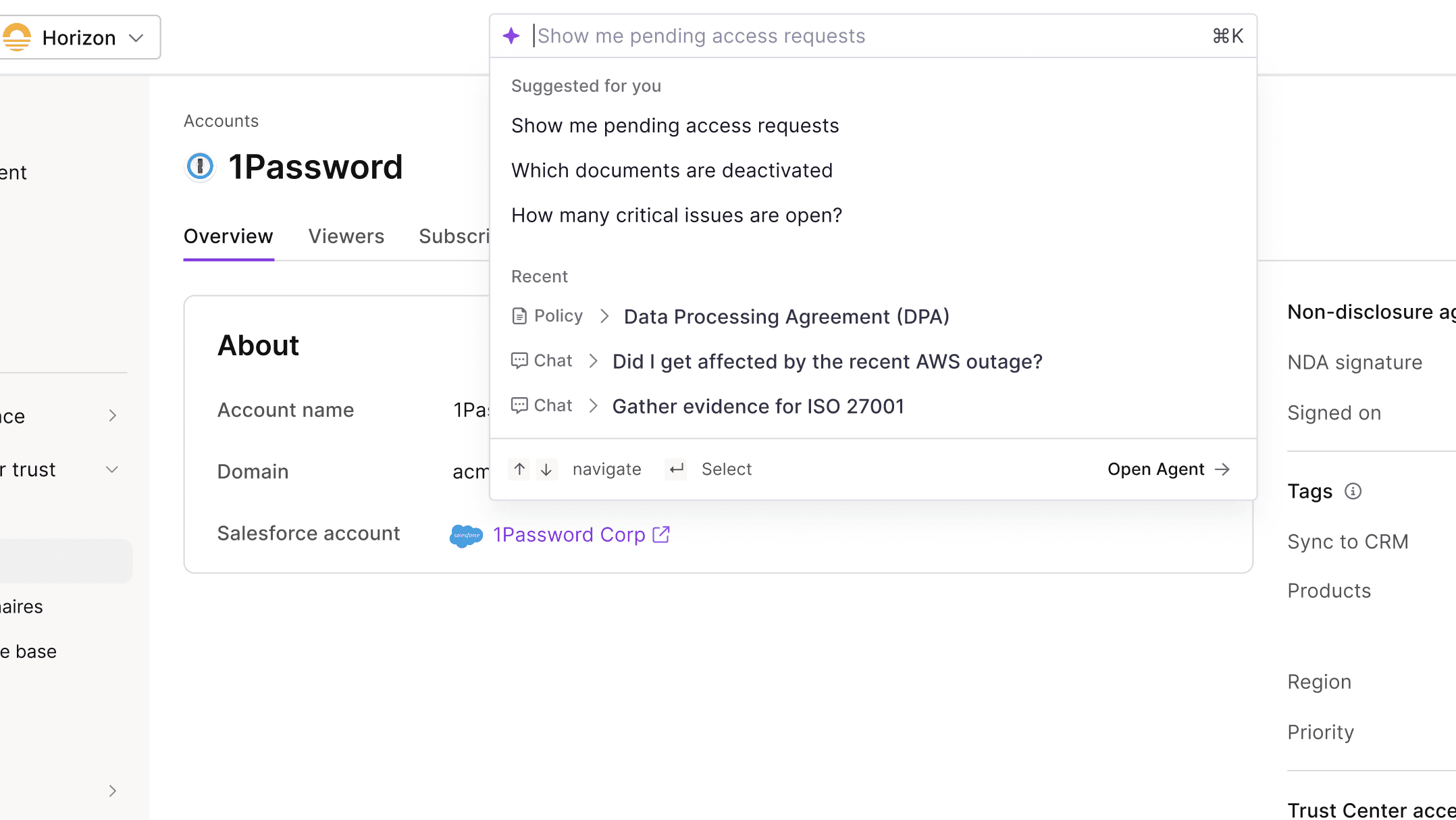
We didn’t want Vanta to feel AI-washed, so instead of adding a new AI button, we tested building the agent into an existing habit. We moved our page search, previously tucked away in the navigation, to the top of every page and made it a universal entry point. Customers can search for a page or ask the agent. Questions open the agent in a side panel, so customers stay on the page they’re asking about.
Rotating prompts show what the agent can do right where people already look.
We ran this as an experiment for 30 days to test results, and we saw that the rotating prompts and placement led to a 20% increase in engagement overall
We decided to launch this to all customers and made a few improvements along the way:
We slowed down the prompt animation so that they rotated every 45 seconds.
Recent page views and chat history in the menu
Keyboard shortcuts and visible hints
Visual improvements to strengthen hierarchy
Hypothesis 2: If we turn the agent’s abilities into outcome-named skills, customers will see it as more than a chatbot.
Power users kept typing the same kinds of prompts, which suggested customers were already thinking in outcomes. I designed a model with three layers:
Outcomes customers can see (like “Run gap analysis”)
Tool calls shown only as progress while the agent works
Underlying capabilities that stay hidden.
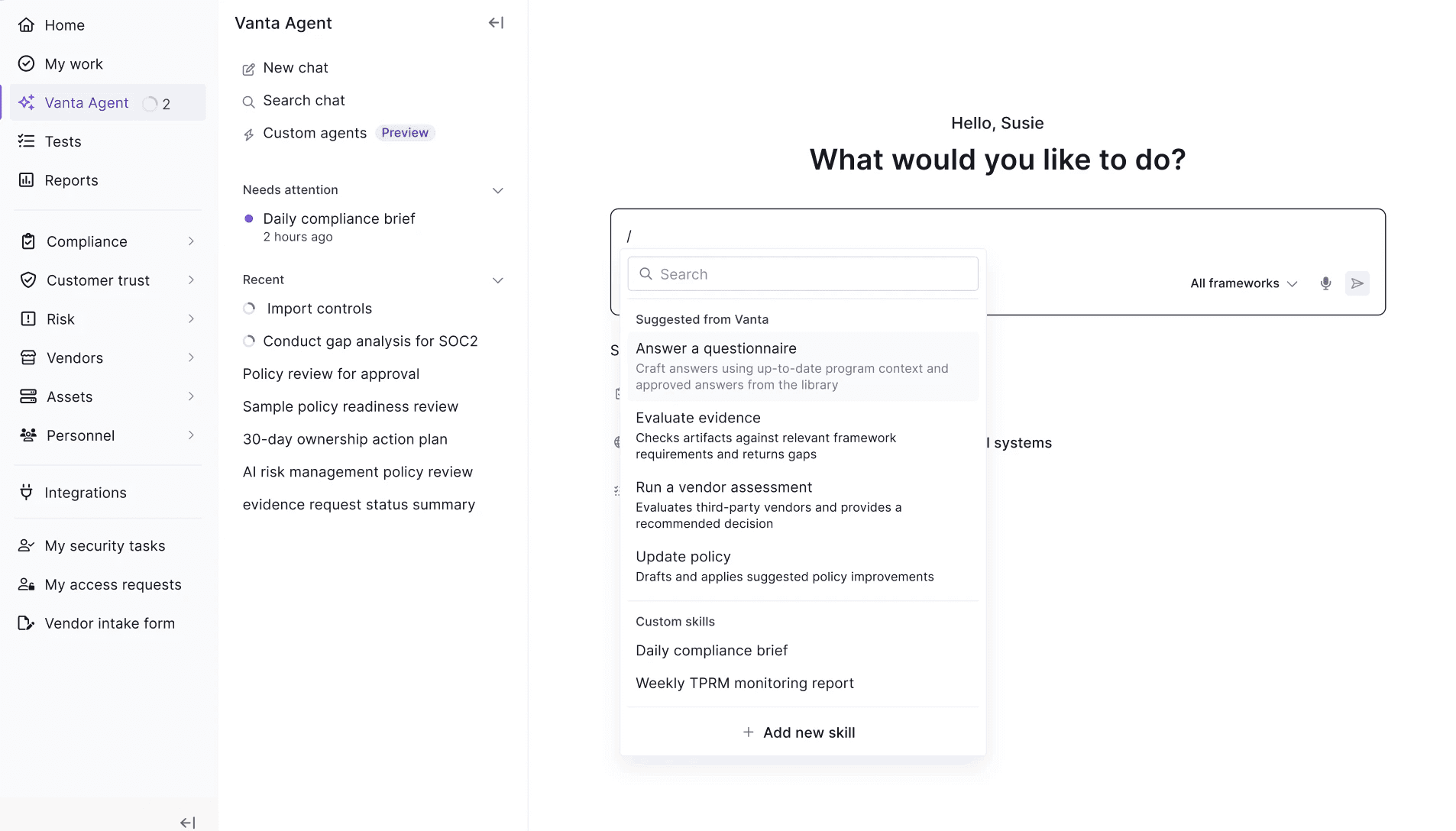
Skills became the test: outcomes named in customer verbs, available through a slash-command picker. Type “/sweep,” choose “Sweep my evidence,” and the agent goes off to find evidence across connected sources.
Below are a few highlighted explorations as I played with the skills menu as well as the representation in the chat composer.


Start small, prove the pattern.
The MVP launched with three skills, focused on proving that skills were useful before scaling the library.
Skills are a familiar concept from frontier tools, so we were able to prove this pretty quickly for Vanta.
Post launch improvements
To boost usage and usability, we invested in adding a combo box for easier search within the menu, as well as the ability to create skills directly from the chat composer:
Content guidance
I wrote content guidelines so other teams could add skills consistently, and partnered with Vanta’s GRC subject matter experts to grow the library. I also worked directly in the agent’s system prompt, shaping how skills and suggestions behaved.
Outcome
Agent entry point moved to the top of every page and became part of search
Skills grew from three initial workflows to a full library, including skills customers create themselves
Skills became a core part of getting started in Vanta
REFLECTIONS
Discoverability isn’t only about placement. It’s about putting the agent where intent already lives. Search was where customers went when they needed something, so that’s where the agent belonged.
I also learned that the best features often come from watching what power users already repeat. Skills started as behavior we observed before we designed them.